We make moving and still pictures, we write, teach and produce. Theatre, Film, TV, and Web are our specialities but we've been known to do print and radio also.
Today is the anniversary of the execution of IRA volunteer James Lillis. In December 1922, amid the Irish Civil War, he was tried by the Free State and found guilty of possession of a rifle and ammunition, having allegedly used them in an attack against state forces.
On January 15, the following year, Lillis was taken from his cell in Carlow Military Barracks and shot. He was one of 34 ‘Anti-Treaty’ prisoners executed that month.
A year later, he was re-interred in Dunleckney cemetery outside Bagenalstown, County Carlow. My short story The Volunteer is a fictionalized witnessing of the funeral preceding that re-interment.
This story was commissioned to mark the centenary of the Civil War, and published as part of a collection of contributions by other former writers in residence who had taken their posts with Carlow College in the preceding years.
Reading an excerpt from ‘The Volunteer’ in The Shaw Room, County Carlow Library.
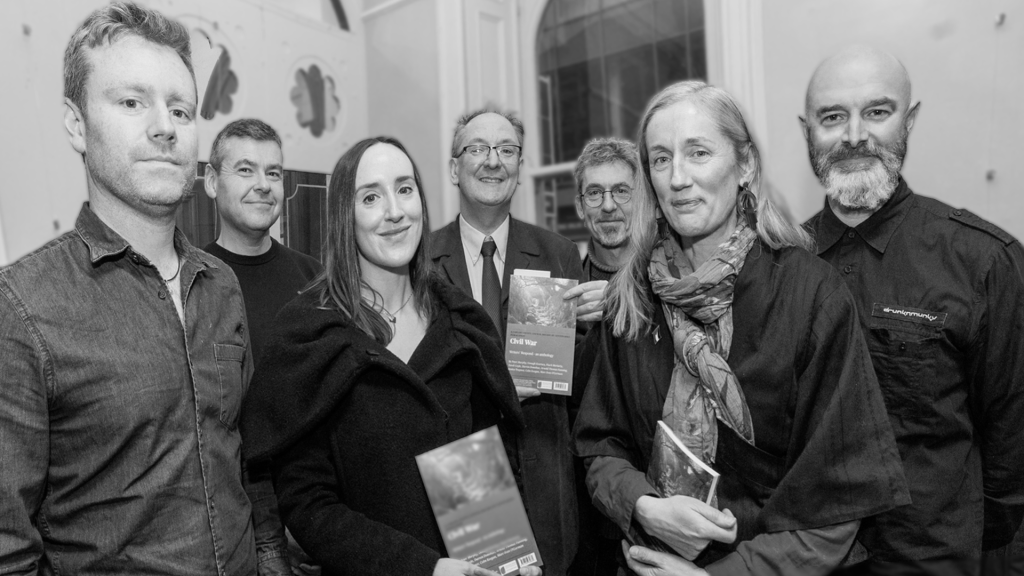
The book was launched last month in the Shaw Room of County Carlow Library. A room so called because the only person to win a Nobel Prize and an Oscar, George Bernard Shaw, donated his local inheritance to the town. Shaw’s mother was a Gurly from Carlow. There is no shortage of paintings and busts of the great man in the building that was once a convent for Presentation Sisters.
Contributors to ‘Civil War – Writers’ Respond’ at the publication launch.
In regard to my story, the location of the launch was most apt. Patriotic James Lillis was a young man who fought and died for his country, but the unnamed narrator of the story who witnesses Lillis’s funeral cannot leave Ireland quickly enough. Contemporaries in the same town but worlds apart with respect to how they view their country. This is because Lillis, a Catholic, and son of a general labourer was a nationalist. The narrator, however, like Shaw, is Anglo-Irish Protestant, middle-class, and decidedly contemptuous of the Gaelic nationalist project. Shaw expressed his position emphatically in a 1916 New York Times article entitled Irish Nonsense About Ireland. Similarly, the narrator in my story cannot fathom Lillis’s sacrifice.
“Patriotism is, fundamentally, a conviction that a particular country is the best in the world because you were born in it….”
― George Bernard Shaw
Though an avowed socialist (most likely the reason he handed over the Gurly properties to the people of Carlow) the author of Pygmalion was dismissive of radical Irish nationalism. A Home-ruler, yes, a Republican never. The fact that this Dubliner made his international reputation in London and via the reach of British global influence would have no doubt shaped his view. A view, it must be remembered, that was shared by a sizeable portion of the population.
The physical force aspect of the Irish Independence movement was controversial at the time and became yet more complicated as the War of Independence morphed into a Civil War. The personal and political conflicts of the period are explored in popular films like Michael Collins starring Liam Neeson and The Wind that Shakes the Barley featuring Cillian Murphy. This same battle of ideas and their expression in violence persisted in Ireland through to the 1990s, as can be seen currently in Say Nothing, a streaming series on “The Troubles”. The efficacy and morality of killing or dying for one’s country is a centuries-old debate, though it is hardly just an Irish problem or even a historic one. In 21st-century Europe, young men continue to fight and die for their country, while others flee for better lives elsewhere. The story one holds about the world can be a matter of life or death.
I’ve been nominated for the James Kirkwood Prize in Creative Writing.
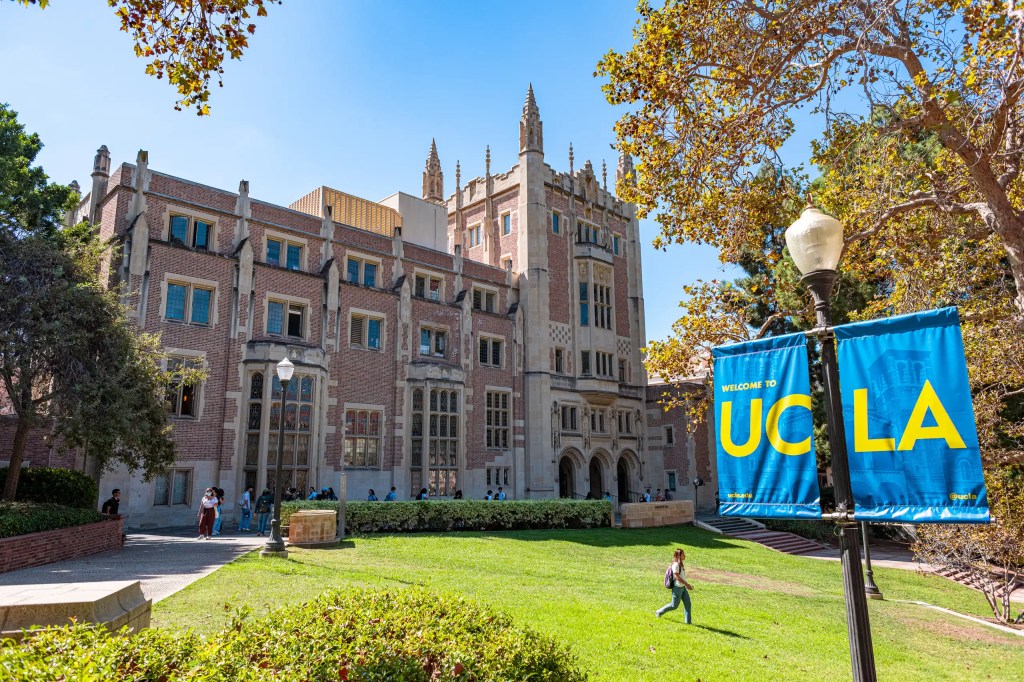
Administered by the UCLA Writers’ Program, the nomination is for a prose work, Away with Us, that I am developing under the auspices of their Writing Certificate, With $2,500, $5,000 and $10,000 awarded for 3rd, 2nd, and first prize respectively, it would be amazing to win, but as all shortlisted artists like to say, it’s an honor just to be nominated.
I have enjoyed studying for the Writing Certificate, which is akin to an MFA, requiring seven 3-unit courses, taken over 2 years. The classes happened over Zoom, and in person, on the leafy Westwood campus in Los Angeles, (a location that entered my imagination as a teenager when I discovered Jim Morrison of The Doors studied there). I have only the final ‘Capstone’ class remaining, which starts in the Fall semester and is being run by poet and memoirist Brian Sonia-Wallace.
Taking classes with an array of celebrated writers has been an extraordinary privilege, the range of their experience, from emerging talents like novelist Chris L. Terry (Black Card, 2019), and short story author, Ploi Pirapokin, to the establishedFrancesca Lia Block, creator of the popular Weetzie Bat series, allowed for a wide diversity of perspectives on my work.
I also gained an immense amount from taking classes in differing genres, where Ploi Pirapokin examined the art of revision, with particular attention to the short story, Rick Bursky(The Soup of Something Missing), offered an introduction to poetry that was both eye-opening and hugely entertaining. Even though I have taught screenwriting for many years in colleges like NYFA, and The Studio School, I decided to take an optional screenwriting class with Andrew Knauer (The Last Stand, starring Arnold Schwarzenegger), and was not disappointed. The certificate reminded me of the common requirements of all forms of narrative writing, that is, create engaging characters, craft artful sentences, and unfurl a compelling story.
So far, I believe I have learned the most from Caroline Leavitt’s approach to story structure, and Aatif Rashid’s breakdown of the different elements of writing the novel. Caroline is the New York Times bestselling author of Is This Tomorrow and Pictures of You, as well as 8 other books, including her latest, Cruel Beautiful World but she cites much of the story structure work of John Truby; while the author of Portrait of Sebastian Khan, Aatif Rashid, was extremely deliberate and sensitive in isolating the individual components of an elegantly composed novel.
I have to thank my employer Bertelsmann for funding my participation in the program, I am very grateful, and being the largest publisher in the world (owners of Penguin Random House), maybe they’ll publish my book one day!
I am excited to announce that I am the recipient of an Arts Acts Grant to develop a new one-act play entitled “Bren The Navvy”. The one-man show is a mixture of music, mystery and memory. Bren is an aviator who has crashed to earth and lost his memory in the fall. Using the scraps of notes and pieces of equipment he is surrounded by, presumably from his damaged aircraft, he tries to piece his life together.
We travel with Bren as he gradually recalls an epic journey across oceans, war zones and romantic love in a show best described as Krapp’s Last Tape meets Memento with songs. Bren’s story is that of a pioneer and, consequently, is replete with the impetus of dreams and blows of catastrophe.
County Carlow Arts Office has again supported my practice, and I am very grateful to receive this funding.
As part of the Irish state’s “Decade of Centenaries” programme, I was commissioned to write a piece, Volunteer, to commemorate the concluding historical event of the decade 1912-1922, the Civil War. Events explored during this time include the likes of The 1913 Lockout and The 1916 Rising.
Free State Army marching over Burrin Bridge, Carlow
I chose the tragic story of Carlow man, Seamus Lillis, who was executed for his activities as an anti-government combatant during the Civil War, which followed the Irish War of Independence.
Mass Card for James Lillis
The story is told from the perspective of a young man, close to Lillis’ age, on the eve of his emigration to America. The narrator sees this new independent Ireland as a country with no place for him, and ponders on the tragedy of men like Lillis dying for something he so readily discards.
I set the story in Duggan’s shop on 59 Dublin Street, Carlow, a premises I grew up in. Over 300 years old, the shop and public house have witnessed all of Ireland’s historical developments from Cromwell’s invasion to The Good Friday Agreement.
Duggan’s Shop, Dublin Street, Carlow (Left of frame, building with 8 windows)
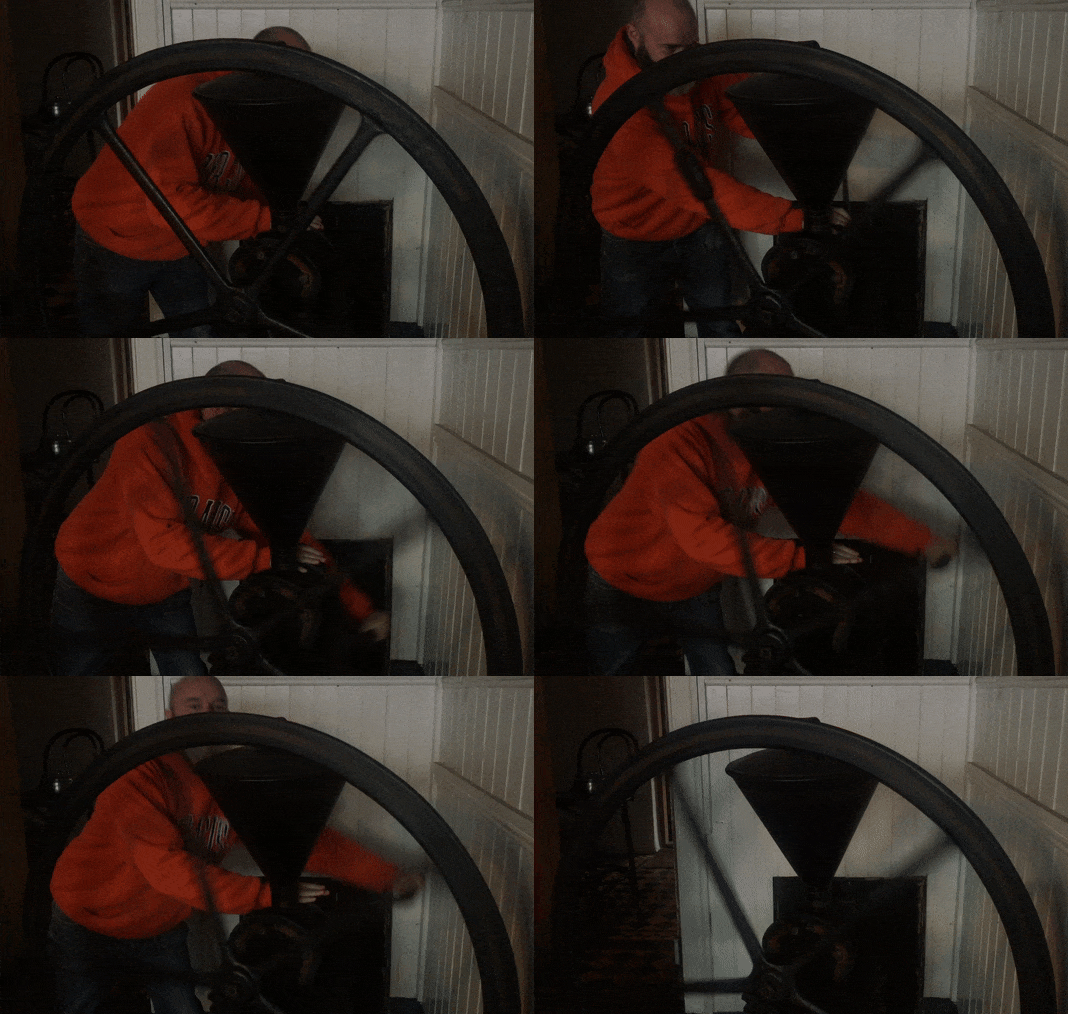
In the corner of the shop, which my parents renamed ‘The Wine Tavern’ (and what I have recently been using as the pop-up art space, TBA Pop-Up), stood, an ancient, person-sized, coffee grinder. It fascinated me as a child, especially because we continued to use it to grind customers one pound bags of Bewley’s coffee beans. I was more often than not the monkey doing the grinding. I imagined it being the silent observer of events 100 years ago and so I feature it in the story, Volunteer.
The Coffee Grinder in Operation
Thanks to County Carlow Arts Office for selecting me to write ‘Volunteer’ and to Christopher Power of Carlow Library for his help in researching it.
It was a dirty old day when they buried him a second time.
October flung a grubby shroud over Tullow street; the ground was still wet from the night before. Killeshin, beyond the crumbling wall of the castle, was fading into a dreary mop of clouds.
I had come into town; I hoped for the last time. The sullen day matched my mood. I should have been in New York eating hamburgers and drinking soda pop, instead I was standing at the counter in Duggan’s, waiting my turn to buy a pound of tea.
The hefty one behind the counter was talking ten-to-the-dozen to the dwarfish one in front of me.
I won’t miss this carry on.
There was no doubt, but the Belgians were going to build their beet factory. The ladies agreed things would change around here when Carlow becomes the industrial hub of the Free State. That’s right, lads, a terrible beauty is born above on the Athy road. I hope it stays fine for them. I’ll be long gone. I should be gone already. I should be looking from the stern of the “SS America”, waves smashing themselves into a froth against the hull, watching Queenstown disappear from view.
Sorry, “Cobh”. That’s the way things are going to be around here now? Eponymous names for everything. “What’s the name of that mountain? ‘Moun-tain’, and that river?, “Ryver”, right, don’t tell me, they call that forest, “Forest”, yeah but spelt, in illogical Gaelic, P H O double R I E A S triple T. Let them at it. It’s not my country anymore.
In the corner, the young fellow was taking his time milling the coffee in the black iron grinder that towered above him. He was winding the wooden handle like a galley slave. The continuous crunching of the roasted beans against the rotating burr spread a friendly aroma throughout the wooden paneled room, and offered the added bonus of almost drowning out the ladies’ prattle.
Gossip from the old ones covered recent deaths (someone was always after dying in this town) and the day’s news (Dev getting arrested in Newry). Watching the wheel of the grinder spin, I drift off, imagining covered wagons rumbling over the desert, or the piston wheels of a massive engine pulling out of Chicago to bisect vast wheat fields of Illinois. The flickers are my only source of information about America. I’m sure none of it is true, but it has to be better than this place.
Would I ever come back?
No.
Maybe to visit, never to live.
Never to live.
I am convinced the old pair will sell up and move to England. Why would they stay? It is their home and the home of their parents and grandparents, but there is no future for them here now. My father made his objections known loud enough and often enough to raise the ire of many a proud nationalist. They were lucky they weren’t burnt out of it years ago. It could still happen.
It makes no odds to me. I’ve spent as much time in Surrey as I have here. Of course, around Cranleigh, or Horsham, I was the Mick and the Paddy. Oh tug of the forelocks and clean out the lower yard. But don’t you worry, I never missed an opportunity to remind them that it took one of my kind, an Irishman, to put a stop to Napoleon. They didn’t like that, the boys of the lower sixth, primed as they were to take up the reins of power in the pink parts of the map. Ex Cultu Robur. From culture comes strength. So It was the lusty recitation of “Ode to a Grecian Urn” that persuaded the Nawab to hand over Calcutta to Clive and not the 42 pound shot that was showering down on him. Culture. It didn’t appear to me that there was too much interest in the soul-nourishing qualities of art for art’s sake. Padding up for the first eleven, or executing a stiff-arm tackle in your own 22, were the sort of things that made you Head Boy. When it inevitably came to leading your small band of men to dominate a continent of discontents, being well-drilled and tight-knit was more important than your appreciation of the Pre-Raphaelites.
I kind of hated them all, and not just because they’d never accept me into their club. I would go wandering alone on the Weald and kick the heads off daffodils. The rolling hills littered with copses of Field Elm reminded me of Ireland. I don’t know why, but it always made me think of Clogrennane Woods.
As I sped to and from Waterloo on the Great Western, amid the passing green blur, my mind would drift back to climbing over Rochfort’s ruin as a young lad off on summer adventures.
Waterloo, sure wasn’t that the place my boy, Irish Arthur Wellesley, put manners on little Boney. That would stick in their craw alright.
“Amelia Rochfort was in buying wine and whiskey for her party”, I heard the woman behind the counter say. “She’s a grand age but you wouldn’t get much past her”. Was this woman reading my thoughts? Suddenly, I was interested in their chat. The boy had stopped turning the handle but momentum kept the wheel spinning in a pleasant thumpity-thump of my future transcontinental journeys. “She cleaned us out, it’s going to be a big do”. Right, this was the Rochfort’s farewell party. I had heard about it, though no sign of an invite to the goodbye bash at the big house. After 100s of years, the family is doing what I’m doing and getting the hell out. Rats and a sinking ship. Though I’m volunteering to leave. They’re forced out by the ghost of Reverend Robert Rochfort, the Slashing Parson. I wonder will he turn up at the party like Banquo, in his clerical garb, wielding his cat-of-nine-tails dripping with the blood of executed Croppies? It’s a hard thing to live down, even in death.
A moon-faced girl enters the shop carrying her barrel hoop and says in a timid voice that the James Lillis funeral is coming. The big one comes from behind the counter and, with an air of propriety, shuts the front door and turns off the lights. The boy puts his shoulder to the wheel to slow its spinning. The room becomes silent. I hear the footsteps of a large crowd approaching. This is obviously a significant event, but I’m lost; I don’t know who this fellow is. The same woman tells the dwarfish one that it’s the exhumed body of the Volunteer they shot last year, and it starts to come back to me.
A year younger than the century but a year older than me, Lillis was found in possession of a gun and executed by the government. Across the whole country, perhaps, ninety IRA men were rounded up and put to death, but Lillis was the only one to be shot in this town.
“It’s the likes of Dev that are to blame for putting the gun in that young man’s hand.” the rotund one says, “It should have been him that was shot, the Spanish blackguard, not some poor unfortunate from Bagnalstown.” “They only went after him because he switched sides” replies the other. “Not at all.” the fat one splutters, “He only pretended to be a Free Stater to get into the barracks; he was setting them up for an ambush. But for whatever reason, it never happened, and he had to go into hiding. Either way, they weren’t satisfied until they hunted the fellow down and had him shot.”
From what I can remember of the case, Lillis was caught somewhere around Borris and then brought to Dublin to be tried. Like that Englishman, Childers, if you were caught with a gun you were condemned to death. Once they had decided his fate, they sent him back to the barracks in Carlow. Would they have buried him there, on-site? There is hardly a graveyard in the barracks? I wonder how many people have met their maker up there? They must have executed a hundred people there during the Rebellion. Of course, there’s no end to the killing still happening around this country. If I stick around, I might end up like those lads in Dunmanway.
“Imagine, he was a month up there in the barracks waiting to be shot, the poor crater.” “I heard they were going to break him out, but he wouldn’t go along with it because he thought he’d get a reprieve.” “And then they dragged him out and shot him in the coal yard; you wouldn’t treat a dog like that.” “He shouldn’t have been in Castledermot shooting at national army soldiers from behind hedges.” “He was a volunteer, Mary; that’s what was expected of him.”
Did he volunteer for this? To be shot on a bitter winter’s morning in his 23rd year. To spend his last days carving his name into a door frame of a damp cell? Is that what he signed up for? Did he really choose? I wonder if this role was given to him, a role he felt he had no choice but to take. I know nothing about him, but I have seen how people behave in this country. They do what’s expected of them. I say that, but my father was dead set on me, following in his footsteps. I can’t say I’m sorry to disappoint him. It’s fine; he has another son to mould in his image – the poor bastard. But it leaves me with only one choice: exile.
The carriage appears in the shop window carrying a coffin draped in a tricolour. I take off my hat. The women fall silent. A mass of ashen faces follows the hearse. Like a weird dream, the unsettling quiet is only checked by the tramp of feet and the sound of the horse’s hooves. There’s some crowd of mourners. Is the father who named him or the mother who bore him among that number? What a difference a year makes. He gets a hero’s farewell the second time of asking. He would have liked that. But given the choice, would he have preferred to meet a nice girl and have a clatter of ruddy-faced sprites like the ones in this shop? Maybe, given the chance, he’d leave the country like me. He’d go see the world. He’d have done something with his life. But he volunteered.
The last of the cortege pass, and after a respectable moment, the shop woman puts the lights back on, adding brightly, “You know, we were the first business in town to get electricity”. She indicates to the young fellow, dully scratching his neck, to resume grinding. Returning to her original position, she asks, “Now, what is it you’d like?”
Marc-Ivan O’Gorman 2022
‘Volunteer’ was commissioned by the Irish Government’s Department of Arts, Culture and the Gaeltacht to commemorate the ‘Decade of Centenaries’.






 Marc-Ivan O'Gorman