Today is the anniversary of the execution of IRA volunteer James Lillis. In December 1922, amid the Irish Civil War, he was tried by the Free State and found guilty of possession of a rifle and ammunition, having allegedly used them in an attack against state forces.
On January 15, the following year, Lillis was taken from his cell in Carlow Military Barracks and shot. He was one of 34 ‘Anti-Treaty’ prisoners executed that month.
A year later, he was re-interred in Dunleckney cemetery outside Bagenalstown, County Carlow. My short story The Volunteer is a fictionalized witnessing of the funeral preceding that re-interment.
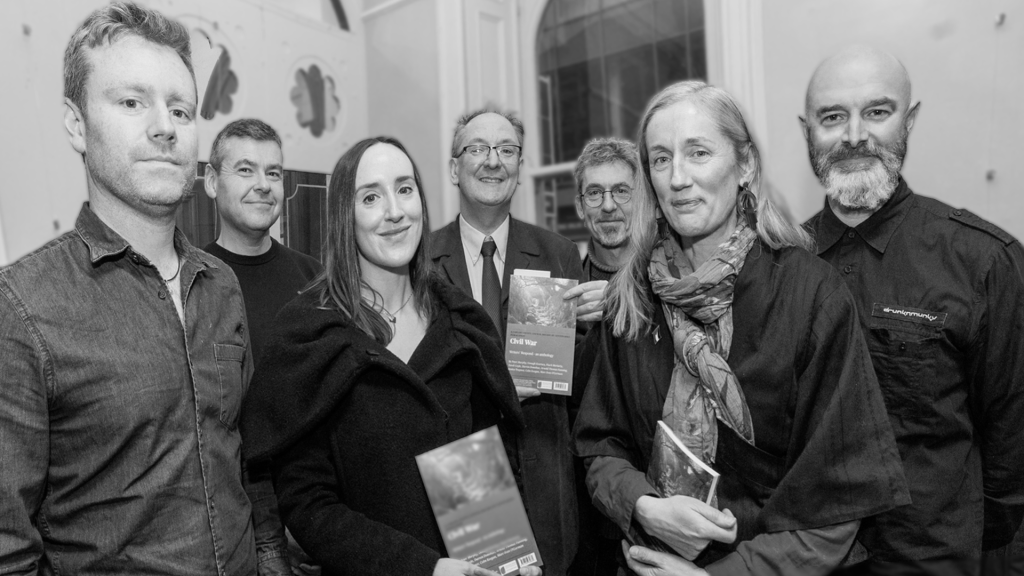
This story was commissioned to mark the centenary of the Civil War, and published as part of a collection of contributions by other former writers in residence who had taken their posts with Carlow College in the preceding years.

The book was launched last month in the Shaw Room of County Carlow Library. A room so called because the only person to win a Nobel Prize and an Oscar, George Bernard Shaw, donated his local inheritance to the town. Shaw’s mother was a Gurly from Carlow. There is no shortage of paintings and busts of the great man in the building that was once a convent for Presentation Sisters.
In regard to my story, the location of the launch was most apt. Patriotic James Lillis was a young man who fought and died for his country, but the unnamed narrator of the story who witnesses Lillis’s funeral cannot leave Ireland quickly enough. Contemporaries in the same town but worlds apart with respect to how they view their country. This is because Lillis, a Catholic, and son of a general labourer was a nationalist. The narrator, however, like Shaw, is Anglo-Irish Protestant, middle-class, and decidedly contemptuous of the Gaelic nationalist project. Shaw expressed his position emphatically in a 1916 New York Times article entitled Irish Nonsense About Ireland. Similarly, the narrator in my story cannot fathom Lillis’s sacrifice.
“Patriotism is, fundamentally, a conviction that a particular country is the best in the world because you were born in it….”
― George Bernard Shaw
Though an avowed socialist (most likely the reason he handed over the Gurly properties to the people of Carlow) the author of Pygmalion was dismissive of radical Irish nationalism. A Home-ruler, yes, a Republican never. The fact that this Dubliner made his international reputation in London and via the reach of British global influence would have no doubt shaped his view. A view, it must be remembered, that was shared by a sizeable portion of the population.
The physical force aspect of the Irish Independence movement was controversial at the time and became yet more complicated as the War of Independence morphed into a Civil War. The personal and political conflicts of the period are explored in popular films like Michael Collins starring Liam Neeson and The Wind that Shakes the Barley featuring Cillian Murphy. This same battle of ideas and their expression in violence persisted in Ireland through to the 1990s, as can be seen currently in Say Nothing, a streaming series on “The Troubles”. The efficacy and morality of killing or dying for one’s country is a centuries-old debate, though it is hardly just an Irish problem or even a historic one. In 21st-century Europe, young men continue to fight and die for their country, while others flee for better lives elsewhere. The story one holds about the world can be a matter of life or death.

 Marc-Ivan O'Gorman